


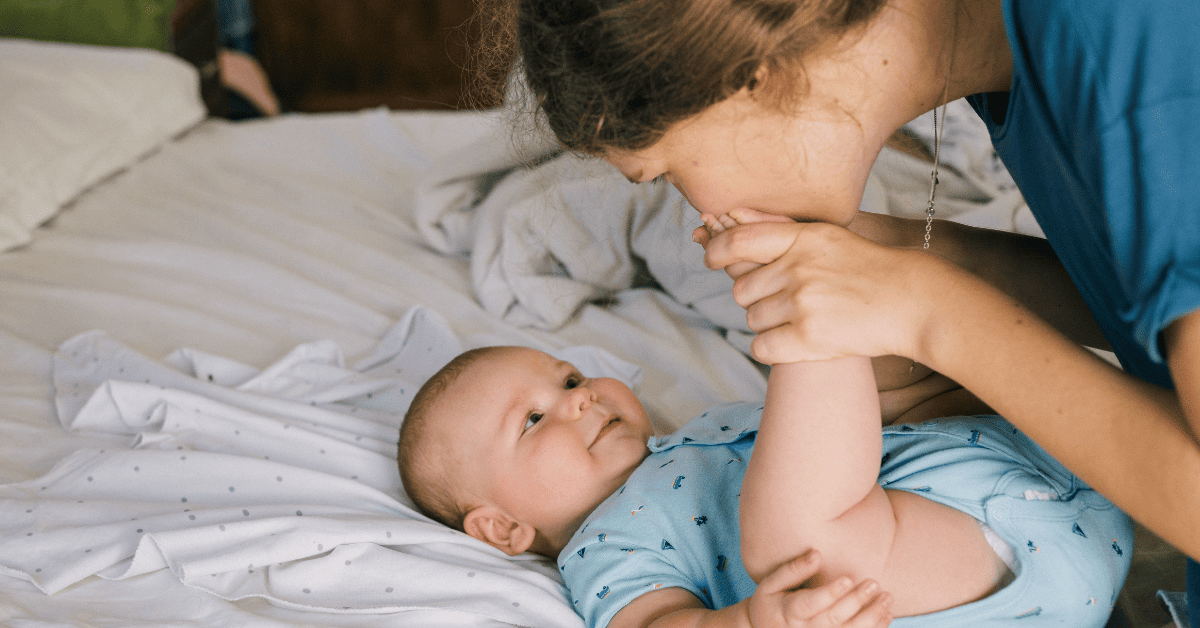
acozyfuture.com - When do babies make eye contact? Many new parents worry when their newborn seems to look past them instead of at them.
It can feel unsettling, especially when you’re waiting for that first meaningful gaze. The good news is that eye contact develops gradually as your baby’s vision matures.
Here’s what’s normal, when it typically happens, and how to support healthy newborn vision milestones.
Table of Contents:
- When Do Babies Make Eye Contact?
- How Newborn Vision Develops (Birth to 6 Months)
- The Science Behind Eye Contact and Brain Development
- Eye Contact vs. Visual Tracking: Understanding the Difference
- Premature Babies and Adjusted Age
- Why Some Babies Avoid Eye Contact (And When It’s Normal)
- Cultural and Personality Differences
- When to Be Concerned
- Eye Contact and Early Signs of Autism: What Research Suggests
- How to Encourage Healthy Eye Contact
- Common Myths About Baby Eye Contact
- Frequently Asked Questions
- Key Takeaways: When Do Babies Make Eye Contact?
When Do Babies Make Eye Contact?

Most babies begin making brief eye contact between 6 and 8 weeks of age. By 2 to 3 months, eye contact becomes more sustained and socially responsive.
If your baby was born prematurely, these milestones should be measured using their adjusted age, not their birth date.
It is important to understand that eye contact develops gradually. A newborn may appear to look at your face in the first few weeks, but true eye contact involves mutual gaze and engagement, not just staring.
📝 Real social eye contact includes responsiveness, facial expression exchange, and shared attention.
How Newborn Vision Develops (Birth to 6 Months)
Birth to 4 Weeks
Newborns are born with limited vision, roughly equivalent to 20/400 visual acuity. They can see best at a distance of 8 to 12 inches, which conveniently matches the distance between a baby’s face and a parent or a caregiver during feeding.
At this stage:
-
Vision is blurry
-
Babies prefer high-contrast patterns
-
Gaze is brief and often reflexive
They may momentarily lock eyes, but this is not yet intentional social engagement.
6 to 8 Weeks
Around 6 to 8 weeks:
-
Babies begin making brief intentional eye contact
-
Social smiling starts to appear
-
Face tracking improves
This is typically when parents notice their baby truly “looking at them” for the first time.
2 to 3 Months
By 2 to 3 months:
-
Eye contact lasts several seconds
-
Babies recognize familiar caregivers
-
Facial expressions become interactive
This is when mutual gaze becomes part of early communication.
4 to 6 Months
Between 4 and 6 months:
-
Eye coordination strengthens
-
Babies track moving objects across midline
-
Eye contact is used to initiate interaction
At this stage, eye contact becomes an important social tool rather than just a visual milestone.
Read More: When Can Babies See Color? A Sensory Development Timeline
The Science Behind Eye Contact and Brain Development
Eye contact is not just a visual skill. It plays a major role in early brain wiring.
Visual Cortex Development
During the first months of life, the brain forms millions of new neural connections. Visual experiences, including eye contact, stimulate the visual cortex and strengthen these pathways.
The “Social Brain” Network
Mutual gaze activates parts of the brain involved in:
-
Emotional processing
-
Social bonding
-
Early empathy
Eye contact also supports the development of joint attention, which is the ability to share focus on an object or person. Joint attention later supports language development.
Hormones and Attachment
When a parent and their baby make eye contact:
-
Oxytocin levels increase
-
Stress decreases
-
Attachment security strengthens
This is why those quiet moments of gazing at your baby feel so powerful. They are biologically meaningful.
Eye Contact vs. Visual Tracking: Understanding the Difference
Many parents confuse eye contact with visual tracking.
-
Visual tracking means following a moving object with the eyes.
-
Eye contact means engaging socially with another person.
A baby may track a toy but not consistently make eye contact yet. These skills develop on overlapping but separate timelines.
Premature Babies and Adjusted Age
If your baby was born early, milestones should be measured using corrected age.
For example:
If your baby was born 2 months early and is now 4 months old chronologically, their adjusted age is 2 months. In this case, eye contact expectations should align with a 2-month-old.
If concerns arise, your pediatrician may recommend vision screening or referral to a pediatric ophthalmologist.
Why Some Babies Avoid Eye Contact (And When It’s Normal)

It can be unsettling if your baby looks away frequently. In many cases, this is normal.
Normal Reasons for Looking Away
-
Overstimulation
-
Fatigue
-
Self-regulation
-
Temperament differences
Babies often look away to process information or calm themselves.
Cultural and Personality Differences
Some babies are naturally more observant and less expressive. Cultural expectations around eye contact also vary.
Limited eye contact does not automatically signal a problem.
When to Be Concerned
You should speak with a pediatrician if:
-
There is no eye contact by 3 months
-
There is no social smile by 3 months
-
Your baby does not track moving objects
-
Your baby does not respond to familiar faces
Early evaluation can help rule out vision issues or developmental delays.
Eye Contact and Early Signs of Autism: What Research Suggests
Reduced eye contact can be one of several early indicators associated with autism spectrum disorder. However, eye contact alone does not diagnose autism.
Other early signs may include:
-
Limited response to name
-
Delayed joint attention (around 9 to 12 months)
-
Reduced social smiling
-
Limited engagement with caregivers
Pediatric developmental screenings are necessary for proper evaluation. If concerns arise, early intervention significantly improves outcomes.
Read More: Are All Babies Born with Blue Eyes? The Truth Revealed
How to Encourage Healthy Eye Contact
You can gently support your baby’s visual and social development through simple daily interactions:
-
Hold your baby 8 to 12 inches from your face
-
Use exaggerated facial expressions
-
Talk and sing frequently
-
Practice “serve and return” interaction
-
Make eye contact during diaper changes
-
Prioritize skin-to-skin bonding
-
Avoid screen exposure under 18 months
Follow your baby’s cues and avoid overstimulation. Short, positive interactions are most effective.
Make Every Diaper Change Easier with Cozycove Diapers
From snuggly newborn moments to chasing after an always-on-the-go toddler, the diaper you choose makes a real difference. The right mix of comfort, protection, and ease can turn everyday diaper changes into a smoother, more stress-free experience.
That’s exactly what Cozycove Diapers are made for. Carefully crafted to keep your little one dry, content, and comfortable all day and night.
With soft, breathable materials and a super absorbent core, Cozycove Diapers provide reliable leak protection while staying gentle on delicate skin. Less mess, fewer worries, and more peace of mind for you.
Choose Cozycove Diapers for cozy comfort and dependable care your baby can feel.
👉 Check this out:
Cozycove Snooze On Diapers (Travel Pack)
Cozycove Play Hard Diapers (Travel Pack)
Common Myths About Baby Eye Contact

Myth 1: Babies should make eye contact from birth
Newborns have limited visual acuity and cannot sustain social gaze immediately.
Myth 2: Avoiding eye contact always means autism
Occasional gaze aversion is normal, especially when overstimulated.
Myth 3: A 2-month-old should have perfect eye contact
Eye coordination continues developing well into early infancy.
Myth 4: Screens improve visual development
Excessive screen exposure can interfere with social interaction and development.
Frequently Asked Questions
Is it normal for a baby to avoid eye contact?
Yes. Newborns may briefly avoid eye contact due to immature vision, fatigue, or overstimulation. Looking away is also a normal self-regulation behavior. However, if a baby consistently avoids eye contact beyond 3 months or shows no social engagement, parents should consult a pediatrician for further evaluation.
What are the warning signs of autism in babies' eyes?
Possible early signs include limited eye contact, reduced response to facial expressions, delayed joint attention by 9 to 12 months, and lack of social smiling. However, eye contact alone does not diagnose autism. Developmental screening by a pediatrician is required for accurate assessment.
When should a baby start making eye contact with you?
Most babies begin brief eye contact between 6 and 8 weeks of age. By 2 to 3 months, eye contact becomes more sustained and socially interactive. If a baby is not making any eye contact by 3 months, a pediatric evaluation is recommended.
Should 2 month olds give good eye contact?
At 2 months, babies typically show emerging but not perfectly steady eye contact. They may hold your gaze for several seconds and respond with smiles. Eye coordination continues developing during this period, and engagement generally becomes more consistent by 3 months.
Key Takeaways: When Do Babies Make Eye Contact?
-
Most babies begin making eye contact between 6 and 8 weeks
-
Consistent social gaze develops by 2 to 3 months
-
Adjust expectations for premature babies
-
Eye contact supports brain development and bonding
-
Lack of eye contact beyond 3 months should be evaluated
If you are ever unsure about your baby’s development, speaking with your pediatrician can provide reassurance and guidance.
💡 Check out our month-to-month baby development guide and keep an eye out for more helpful guides coming your way soon!
Share:
Should You Change a Diaper During Night Feeds?
When Can Babies See Color? A Sensory Development Timeline